

Overview
Philosophy
Omni bets on PostgreSQL. Instead of stitching together separate systems for storage, search, and message queuing, Omni uses PostgreSQL for all three. Services communicate through a message queue backed by a PostgreSQL table. The same database handles full-text search and vector search. One database to deploy, monitor, back up, and understand.Why Postgres?
Enterprise search typically means running a primary database alongside a dedicated search engine like Elasticsearch and a message broker like Kafka, plus the glue code to keep them in sync. That’s significant operational overhead for most organizations. Omni takes a different approach by building on ParadeDB - PostgreSQL with the pg_search extension, powered by Tantivy. Tantivy is a Rust-based inverted index architecturally similar to Lucene, the engine behind Elasticsearch. Combined with pgvector for embeddings, you get hybrid search (keyword + semantic) with sub-second latency at millions of documents - all in PostgreSQL. For message queuing, Omni uses PostgreSQL tables with row locking. This adds polling overhead compared to Kafka, but document indexing workloads measure in thousands of events per hour, not millions per second. The simplicity tradeoff is worth it. A single generictasks table now backs multiple workloads — including document embeddings — with claim/lease, retry, deduplication, and dead-letter handling shared across the Rust and Python services.
Omni is designed for organizations with up to ~5 million documents. Beyond that scale, you may want to introduce read replicas or evaluate a dedicated search tier, but most enterprises never get there.
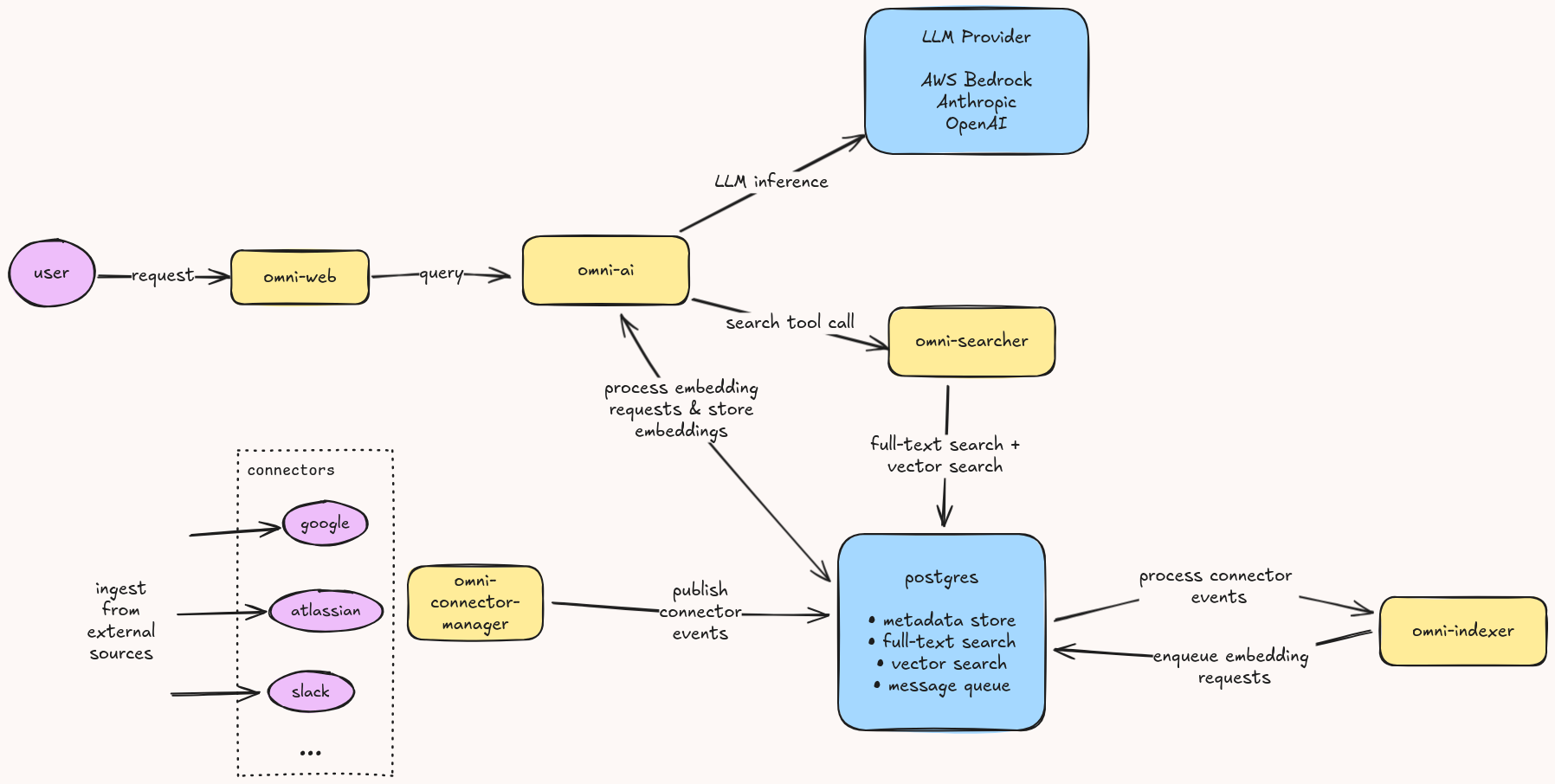
Components
Permissions
Omni inherits permissions from source systems. Users only see documents they have access to in the original source.- Sync: Connectors pull permission metadata alongside documents
- Store: Permissions are stored in PostgreSQL, linked to each document
- Query: Every search filters results by the requesting user’s access
- Refresh: Permissions re-sync periodically or via webhooks
Next Steps
Deploy Omni
Choose your deployment strategy
Configure Connectors
Connect your data sources